Monday, 5 September 2022

Carbon Conference 2022

The 2022 World Conference on Carbon was held at Imperial College London in early July. Given the tumultuous time, it felt remarkable to be sitting in the introductory lecture and welcomed by Prof. Geoff Fowler. It was especially remarkable for me as I had travelled on one of the longest flights in the world from Perth to London (17 hours) to be there. Here are some of my thoughts from my great week in London.

Carbon for a Clea​​​​ner Future 

The theme for this year's conference was "Carbon for a Cleaner Future", which is an apt theme for a world in need of carbon to rapidly decarbonise. We heard from excellent plenary speakers including Prof. Novoselov on graphene, Prof. Bandosz on the chemical effects within porous carbon, Prof. Conchi Ania on lighting up nanoporous carbons for catalysts, Prof. Marc Monthioux on carbons mimicking water droplets on a spider's web and Prof. Milo Shaffer on assembling scalable nanocarbons! I filled many more pages of notes from other excellent speakers and presenters throughout the conference. 

Industry at the cutting edge

Another highlight was meeting and hearing talks from industrial scientists at the cutting edge of carbon science. It was remarkable to see the work on reducing the power and degradation of graphite furnaces from Dr Timm Ohnweiler at Carbolite furnaces. 

LinkedIn post from Carbolite

Brian Kelly award

I was very grateful to receive the Brian Kelly Award from Prof. Fowler at the beginning of the conference. The work for which I was awarded the prize is close to that of Prof. Kelly's. In 1981, he wrote, 
"The material presented shows that graphitisation is not a simple process, and it is not well understood." Brian Kelly, Physics of Graphite, 1981

Here is the personal story of the discussions and collaborations from past Carbon conferences that led to the work I presented in London. 

In 2017, at the Melbourne Carbon Conference, I met Dr Nigel Marks, Dr Irene Suarez-Martinez and Dr Carla de Tomas from the Carbon Group at Curtin University in Perth, Australia. I was in the middle of my PhD on soot/carbon black formation at the University of Cambridge but became fascinated by the disordered carbon structures the Carbon Group had prepared using molecular dynamics simulations that were able to capture all of the features in glassy and porous carbons. I visited Perth briefly and started to work on these structures with the group, employing some novel visualisation approaches of 3D printing and analysing the structures using a mesh. We managed to find a common nanostructure between the glassy and porous carbons. These disordered carbons also contained an excess of saddle-shaped (net-negative Gaussian) curvature [Martin, Jacob W., et al. "Topology of disordered 3D graphene networks." Physical Review Letters 123.11 (2019): 116105.]. The stacking order in the glassy carbon could then be explained by the sheets winding up to form screw-like defects that enabled a fullerene-like structure to be stacked in particular regions. This provided a potential explanation for the transition from porous carbon to impervious glassy carbon as well as the isotropic properties of the material. 

Model of disordered carbons

I presented this work at the 2019 Carbon Conference in Lexington, USA and was very happy to receive the student prize for the talk. It was the SFEC French Carbon Award talk that drew my attention to graphite. Dr Philippe Ouzilleau spoke about the formation of graphite through a thermodynamic model that was done with Prof. Marc Monthioux and others [Ouzilleau, Philippe, et al. "Why some carbons may or may not graphitize? The point of view of thermodynamics." Carbon 149 (2019): 419-435.]. They firstly showed that graphitisation is a second-order phase transition with a critical temperature around Tc=2550 K. Secondly, they suggested the presence of annealable topological defects in graphite that give rise to the phase transition while in non-graphitising carbons other non-annealable topological defects are present that are unable to be removed. 

In 2020 I was able to join the Carbon Group at Curtin University through a Forrest Fellowship. I began working with Jason Fogg and Kate Putman, both PhD students in the Carbon Group. They had been developing a novel, low-cost approach to heat up carbon to 3000 °C using the furnace in an atomic absorption spectrometer (AAS) [Putman, K. J., et al. "Pulsed thermal treatment of carbon up to 3000° C using an atomic absorption spectrometer." Carbon 135 (2018): 157-163.]. This approach had been discovered by Dr Peter Harris, who had previously asked a colleague in chemistry to use these furnaces to prepare samples for electron microscopy.

Carbon Group at Curtin University (Ms Kate Putman, Mr Jason Fogg, Dr Irene Suarez-Martinez, Dr Jacob Martin, Dr Nigel Marks)

The Atomic Absorption Spectrometer (AAS) was invented in Australia by Alan Walsh at CSIRO in the 1950s. It works by vaporising metals that then absorb light and it is often used for environmental metal tests such as detecting lead contamination. Vaporisation was originally achieved in a flame, however, a small graphite tube furnace has mainly replaced the flame. This small joule heated graphite furnace has been extensively developed since the 1960s to ramp up extremely rapidly (~3000 °C/s) and have power control to reproducibly control the temperature. Both time and temperature are critical to control for reproducible measurements. These ramp rates far exceed those for conventional graphite furnaces, which require at least an hour to reach >2500 °C. Given the precise control over the time and temperature, it was the perfect instrument to study graphitisation kinetics and so the Carbon Group worked with GBC Scientific, one of the original Australian companies to commercialise the AAS, to have a custom tube furnace provided. 

Dr Irene Suarez-Martinez and Mr Jason Fogg operating the GBC graphite tube furnace.

This new furnace provided a means to address the problem posed by Prof. Brian Kelly in 1981 for studying graphite. 
"The proper study of the variation of a property (of graphite) with time at temperature is difficult because of the necessity to raise the specimen temperature rapidly to very high levels, and the difficulties associated with very high temperature measurements." 
Brian Kelly, Physics of Graphite, 1981
When I arrived in Perth, I suggested we look at a graphitising carbon and search for an annealable topological defect. Jason prepared samples across the graphitisation transition with varying residence times by applying multiple thermal pulses. I then took the samples to the transmission electron microscope for imaging. This new microscope had a cold field emission gun that provided atomic resolution of the graphite and clearly resolved the interplanar defects as screw dislocations that were removed with heat treatment. To find out how the screws form and are removed we performed molecular dynamics simulations to find the mechanism for their removal. There was a nice connection with the screw dislocations, as Dr Suarez-Martinez studied these in her PhD with the late Malcolm Heggie. 

Electron microscopy and model of a screw dislocation.

We could then probe the kinetics of graphitisation by tracking the crystallites using X-ray diffraction of the pulse heated samples. This revealed that the graphitisation kinetics were more rapid than first thought, occurring on the seconds timescale. The speed at which graphitisation occurs was the aspect that most interested those in the graphite industry at the conference. At 2500 °C, graphitisation takes a few minutes, however, above 2800 °C it takes less than 10 seconds. These insights could have significant cost savings when it comes to industrial production of graphite. Additionally, the removal of screw defects could be targeted to catalyse graphitisation. The preprint for the work is currently online if you would like to read more. A recording of the lecture I gave is also available online

Nanocarbon in virtual reality and 3D printing

Alongside the presentation on graphite, I gave two other talks on the formation of soot/carbon black (recording available online) and also on the visualisations of carbon nanostructures using VR and 3D printing (recording available online). 

During the lunch breaks I was able to demonstrate the virtual reality headset and show people carbon in 3D. It was a lot of fun to see people explore these computational models. We also had the opportunity to view other groups' atomistic structures that were emailed as xyz coordinates, providing a new way to engage with other peoples work. 

Not yet back to normal

Many people were absent from the conference and were sadly missed. Colleagues from China and Japan could not attend due to travel restrictions in their home countries. There were also instances of scientists unable to attend due to global conflict. Dr Yuriy A. Olkhovyk from Ukraine gave an excellent recorded talk on containment of nuclear graphite at Chernobyl. I hope that these barriers will soon be removed within the Carbon community and we can all freely meet at future conferences. 

However, given the situation it was remarkable what the British Carbon Society achieved in spite of terrible uncertainty. I wanted to personally thank them for bringing together an excellent conference programme, expertly planned and executed. 

Molly the anthropomorphic Molymod

Another attendee sorely missed was the late Malcolm Heggie. In memory of Malcolm and to bring his humour back to the Carbon community, Molly was reconstructed out of a Molymod molecular modelling kit.

Another carbon great passed away when the conference was just beginning - Prof. Robert Curl, from Rice University. The winner of the 1996 novel Prize for Chemistry discovered the C60 buckminsterfullerene, the molecule that started my love of carbon. I recommend the well written article from Rice University on Prof. Curl's life

I recall emailing Prof. Curl as an undergraduate to ask for help with a paper. I was working on whether giant fullerenes could be synthesised. He not only responded to my email but organised for someone at Rice to perform an experiment I proposed, however, it was not initially successful. I tried a different approach to heating the fullerenes to size them into giant fullerenes, which ended up working. I sent him the manuscript that was subsequently published in Carbon. He wrote, 

"Thank you for sending me your manuscript on the heat driven solid state coalescence of giant fullerenes in toluene-extracted fullerene soots. I think this paper makes significant progress in understanding this interesting and challenging subject. I am flattered by your offer to join you as an author to this paper, but have to decline. I believe that any contributions I might have made to this work are trivial."
This was followed by extensive feedback on the manuscript. He continued to help me in another projects too. I was fascinated by the lack of fullerenes in fullerene-like carbons such as charcoal. Prof. Curl emailed the late Prof. Sir Harry Kroto and Prof. Alan Marshall to organise some high resolution mass spectrometry to be done at Florida State University. These experiments demonstrated similar oxygen-containing giant fullerene-like fragments, as seen in the giant fullerene paper. This suggested that the heat treated fullerene arc-carbon and charcoal share a common nanostructure. We published this work in Environmental Science & Technology with Prof. Curl again refusing to be on the authorship. 

He also kindly wrote a letter of support for one of my fellowship applications in 2020. I hadn't even met him in person but he agree to support the science present in my application. As a young person exploring carbon science this was extraordinarily encouraging with all of my interactions with Prof. Curl demonstrated his kindness, humility and generosity to a student he had never met.

Conference dinner on the Thames

A significant highlight was having a sit-down dinner on board a river boat and having the tower bridge open for us. The cloudless sky was also a nice touch from the organising committee! 

On board the boat with friends.

I spent the following week in Cambridge with a Covid-induced fever, enhanced by the heat wave, but with no regrets. I can only reiterate words from Prof. Kelly that ring true also for me: 

"The study of these materials has brought me considerable pleasure and the good fellowship of the 'carbon' community." Brian Kelly Physics of Graphite, 1981

Monday, 22 November 2021

What’s in a flame? How soot forms from molecule to particle

Andrew Breeson and I put together this press release that was picked up by PhysOrg on a review paper Maurin Salamanca, Markus Kraft and I recently wrote.

Soot is one of the world's worst contributors to climate change. Its impact is similar to global methane emissions and is second only to carbon dioxide in its destructive potential. This is because soot particles absorb solar radiation, which heats the surrounding atmosphere, resulting in warmer global temperatures. Soot also causes several other environmental and health problems including making us more susceptible to respiratory viruses.

Soot only persists in the atmosphere for a few weeks, suggesting that if these emissions could be stopped then the air could rapidly clear. This has recently been demonstrated during recent lockdowns, with some major cities reporting clear skies after industrial emissions stopped.

But soot is also part of our future. Soot can be converted into the useful carbon black product through thermal treatment to remove any harmful components. Carbon blacks are critical ingredients in batteries, tires and paint. If these carbons are made small enough they can even be made to fluoresce and have been used for tagging biological molecules, in catalysts and even in solar cells.

Given the importance of soot and how long humankind has been producing it, you would think its formation was completely understood. However, this is not the case. In particular, the critical transition when the molecules cluster to form the very first nanoparticles of soot is unknown.

If the origins of soot were to be entirely understood, we could potentially eliminate its formation and therefore drastically reduce its environmental impact as well as make better carbon materials. With this in mind, researchers from the University of Cambridge and Cambridge CARES have recently published a comprehensive review on the birth of soot—where molecules become particles.

In the review, titled: "Soot inception: Carbonaceous nanoparticle formation in flames" published in Progress in Energy and Combustion Science, the authors Dr. Jacob Martin, Dr. Maurin Salamanca and CARES Director Professor Markus Kraft begin by noting that;

"It has only been in the last decade, however, that experimental and computational techniques in combustion science have been able to peek behind the door to reveal insights into the earliest formation mechanisms of carbonaceous particulates in the flame."

The figure below shows some of these new experimental insights along the path from fuel to soot. In this diagram it is nanoparticle formation (soot inception) that is the birth of the soot particle.

The graphical abstract from "Soot inception: Carbonaceous nanoparticle formation in flames" Credit: Jacob Martin

Two main pathways have been suggested for soot inception—either physical condensation in which molecules form droplets or chemical polymerisation in which molecules react to form particles. But either pathway by itself is non-optimal, as "physical and electrical condensation of precursor molecules is rapid but too weak to hold soot together, while most chemical bonds are strong but the mechanisms proposed to date are too slow to account for rapid growth of soot as observed in experiments."

Schematic of various soot nanoparticles arranged as a function of their C/H ratio and molecular weight. Credit: Jacob Martin

Instead, the authors suggest a "middle way" involving mechanisms with both physical and chemical aspects. Promising options are highlighted involving π-radicals and diradicals, however, conclusive evidence for a specific mechanism as well as predictive models are still lacking.

Ultimately, the authors conclude that "the emission of carbonaceous nanoparticles needs to be a research and industrial priority for the future of combustion devices and new material applications."

"Soot inception: Carbonaceous nanoparticle formation in flames" is published in Progress in Energy and Combustion Science by researchers from Cambridge Centre for Advanced Research and Education in Singapore Ltd and University of Cambridge.


Thursday, 5 August 2021

Molecular dance in sooting flames

Below is the press release that was picked up by PhysOrg https://phys.org/news/2021-08-molecular-soot-pollution.html 

A hidden, newly discovered molecular dance could hold the answer to the problem of soot pollution.

Soot pollution causes cancer and blood clots, as well as weakening immune systems to respiratory viruses. The atmosphere and glaciers are also blanketed by soot, leading to global heating and increased ice loss. Surprisingly, the way that soot particles form is still unknown, but is of pressing concern.

The reason for this long-running mystery is due to the extreme environment in which soot forms, the rapid speed of the reactions and the complex collection of molecules present in the flame. All of these obscure the pathway to soot formation.

https://commons.wikimedia.org/wiki/File:Candle_flame_-_Macro_photography.jpg

An international team from the UK, Singapore, Switzerland and Italy has now used two microscopes to reveal the molecules and reactions taking place in a flame. The first microscope operates by touch, feeling for the arrangement of atoms in the molecules of soot. These tactile maps provide the first picture of soot's molecular chicken wire shape. Quantum chemistry was then used to show that one of the molecules was a reactive diradical. A diradical is a type of molecule with two reactive sites, allowing it to undergo a succession of chain reactions.

The first microscope operates by touch, feeling for the arrangement of atoms in the molecules of soot. These tactile maps provide the first picture of soot’s molecular chicken wire. Quantum chemistry was used to determine a new class of reactive molecules, diradicals.

Imaging of a soot precursor molecule and the reactive diradical revealed with quantum chemistry.

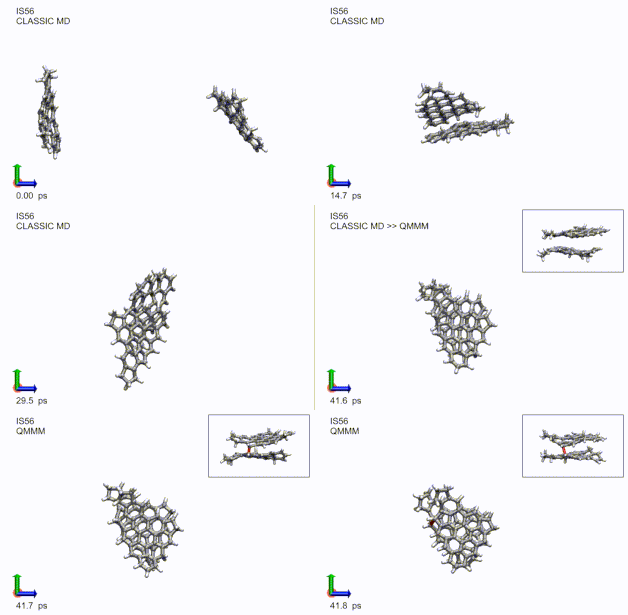
The second microscope is entirely virtual and shows the reaction between the diradicals. Quantum mechanics guided a supercomputer to virtually and realistically collide the molecules together and reveal the molecular dance in slow motion.


This simulation showed that the individual molecules are held together by intermolecular forces after they collide. This gives the reactive sites time to find each other and create a permanent chemical bond. Even after they have bonded they remain reactive, allowing more molecules to "stick" to what is now a rapidly growing soot particle.

This discovery could resolve the problems with previous attempts to explain soot formation via either a physical condensation or chemical reaction. In fact, both are required to adequately explain the rapid and high-temperature reactions.

One of the paper's lead authors, Jacob Martin, said, "If the concentration of these species is high enough in flames, this pathway could provide an explanation for the rapid formation of soot."

Co-author Markus Kraft, from the University of Cambridge's Department of Chemical Engineering and Biotechnology, said, "The project brought together cutting-edge computational modeling and experiments to reveal a completely new reaction pathway which potentially explains how soot is formed. Scientists and engineers have been working on solving this important problem for decades."

The researchers hope to target these reactive sites to see whether the soot formation process can be halted in its tracks. One promising option is the injection of ozone into a flame, which has already been found to effectively eliminate soot in some preliminary results in other work.

More information: Jacob W. Martin et al, π-Diradical Aromatic Soot Precursors in Flames, Journal of the American Chemical Society (2021). DOI: 10.1021/jacs.1c05030

Tuesday, 13 July 2021

Tips for Postdoctoral Fellowship Interviews

Since my PhD I have applied for three different fellowships and interviewed for two. During these preparations, I have aggregated a series of questions and tips for the interview. Quite a few people in my family have also worked in recruiting and provided some more general questions. I thought I would bring these tips and suggestions together in this blog post. In particular, I have seen a lot of lists of questions but few detailed responses as to how to reply to them and what the question behind the question may be. Therefore, I hope this is helpful for those applying for postdoctoral fellowships. 

Know your audience

If you know who will be interviewing you, research them. Think about what motivates them and what sort of answers they might be satisfied with. Do they have an industry or academic background? What has been happening in their region/field recently? Before thinking about your answers it is important to know who you are trying to convince. 

Introductory statement

Often an interviewing panel will ask you to introduce your project over 5-10 mins. If slides are involved in this you will be asked prior to the interview to prepare these. It is important that you follow the narrative you presented in your proposal. I like to add some personal touches to this introductory statement about why I got interested in the topic. I wrote my introductory remarks out in full beforehand and then loosely followed them. Do expect to be interrupted during your introduction as this is often a way of seeing how you do under pressure. 

It is important that this introduction is focused on the impacts and not on methodology. If the interviewers have specific questions about your methodology they will ask them. I also like to show in the introduction that I understand how this research fits into the job's location and what questions people are asking in the location where the fellowship will be held. 

Some important overarching themes you want to communicate in the introduction and in the questions are that you are: 
  • an independent researcher,
  • at the cutting edge of international research,
  • able to connect your expertise with problems or questions ordinary people are interested in.
It is also important to remember that the interviewers will be more interested in your approach to research than the intricacies of your methodology. 

Interview questions

Below are a series of questions I was asked, others were asked or I have scraped from the internet. These are not exhaustive and some are repetitive but hopefully, the comments for each question will help you prepare some responses.
  • Given unlimited resources, what would you do?
    • This question is trying to assess if you are an independent researcher. 
    • Can you frame research questions and plan projects? 
    • It also assesses where you want to go in the future and what your priorities are.
    • This is an opportunity to talk about translating your research from the lab to the industry or the community.
  • Tell us about yourself
    • This is fairly open-ended but is wanting you to go deeper than simply your research project. 
    • This is a helpful question to explain how you are relatable and that you are more than just your work. 
    • I split this question into academic, extracurricular and personal. The academic communities I am involved in are (physics, chemistry, combustion, materials etc). Outside of work I like to (list some hobbies). I would describe myself as a (personal adjectives).
  • What would you say are your research expertises?
    • Depending on your audience I would go for overarching research themes and not a list of methodology or techniques you have mastered, e.g. analytical chemistry for pollution detection. 
  • What hobbies do you have?
    • This question is to help them assess whether you have a life outside of the lab/office. 
  • What inspired you to get into research?
    • I like to focus my answer on big picture issues here. What motivated me to get into research?
    • I also would discuss who inspired me.
    • This question is very useful for including a small story or anecdote.
  • What would you bring to the programme?
    • Concrete ideas are good here and demonstrating some things you have previously implemented. 
    • Include things like mentoring, workshops, public outreach.
  • What is the most pressing problem that you want to address?
    • This is a question about what issue or problem is motivating you. 
    • Make sure this relates directly to your research project and how your work will help to bring us close to solving the problem. 
  • Talk about a time when something goes wrong with research. How did you overcome it and what you learned about yourself.
    • Good opportunity for a story or anecdote.
    • Perhaps focus it on the work and how you overcame a particularly challenging experiment. 
    • I prefer to focus on people. Academy is full of challenging people to work with. How did you manage the relationship? How did you support others? How did you reach out for help from specific people in your department/university? This answer is easier for discussing what you learnt about yourself than a research based question.
  • Why do you want this position? 
    • Opportunity to show them you understand what the fellowship is about and the parts of the fellowship you really like. Check out annual reports and the people they have funded to see what they like to promote. Their social media accounts are also helpful for this.
  • Is perseverance or talent important?
    • These sorts of silly questions are often used where you have to choose between two things that are both important. 
    • I chose to answer the question according to the most important thing for me which is vision which will provide perseverance. For talent I mentioned that I think of talent in a group setting. In good collaborative work many people with different talents come together to get a project done. This answer highlighted broad thinking and team thinking. But it is quite personal so I would write something that is true to your view of this question.
  • Could you tell us about how outreach is important for you?
    • This must be answered in the affirmative and gives you an opportunity to explain the outreach you have already been involved in.
  • What are your breakthroughs and what impact have they had?
    • I like to mention them briefly. My first breakthrough was ... and this changed how the field of ... thinks about the problem. 
    • You might want to add how these breakthroughs will make further impact through the project you are proposing. 
  • What do you see as a weakness of yours? 
    • There are some common answers to this question that you want to avoid if you can. e.g. I overwork, I come up with too many ideas etc. 
    • This is an opportunity for you to get personal about an aspect of your research you or others have noticed needs improving.
    • Talk about what steps you are taking to strengthen this part of you and perhaps how this programme will help. 
  • What is your greatest strength?
    • This is not an opportunity to talk about all of the great research you have done or all of the ideas you have had. 
    • Focus it on soft skills and provide evidence for your statements. I am a team player and this can be seen in how I worked in my last group when ...
  • Can you explain some of the novel aspects of your project?
    • Good to talk about the critical difference between others in the field and what you are proposing. 
    • What is the unique spin you are bringing to the problem/question that will hopefully lead to a breakthrough?
  • What would you do if you don’t get this application?
    • I mentioned grants I have applied for. Avoid talking about other fellowships as they might think you're not serious about this one. 
  • What are some risks in your project and how will you overcome them?
    • This is an opportunity to talk generally and nonspecifically about barriers and how you overcame them. 
    • COVID-19 is a good thing to talk about here. Risks of not being able to collaborate as widely and how you can mitigate these risks by engaging in online conferences. 
  • How did your research proposal come about?
    • Important you demonstrate your independence and how you made this happen. 
    • Discuss the world-class group(s) you will be working with and why this is the best place to do this work.
  • Why is it important to do this research now?
    • This is a big picture question. Discuss the big question/problem and how this research addresses this. Also make it regional - why is this important for the place the fellowship will be undertaken?
  • Who else is currently working in this field?
    • This is a question aimed at working out how well embedded you are in academic circles. Who have you met and collaborated with? Have you attended conferences/workshops where these groups were presenting? What are they doing that is similar and what are you doing differently?
  • Will you be using any new techniques?
    • This could be a trick question as new techniques can be problematic and can delay a project. The easiest projects are those that bring two well-known approaches from two different fields together for the first time. 
    • I like to talk about the new aspects or new ways we will be using the equipment but also say that the group I am going into is world leading in the techniques I want to use. 
  • How will you measure success during the course of your fellowship?
    • I would not say papers; this is a question about output.
    • I would talk about outputs from the projects and the impacts of those outputs. 
  • What impact might this research have on your field?
    • This is simple question but might be nice to talk about problems/questions that cannot be solved/answered that will be possible after this project. 
  • What sort of socio-economic impact will your projects have?
    • I would start with the facts around how much money you think this could save/generate. 
    • You want to head quickly into the positive social benefits and how you understand what it will mean for the people where the fellowship is based.
  • How would you describe your proposed research to a non-scientist?
    • This needs to be a 1-2 minute elevator pitch. You need some sort of hook to generate interest and explore what your research does in the context of a non-scientist. 
  • How will you communicate your research to a broader audience?
    • This is not papers. Think press releases, social media, trips to schools, blog posts, visiting companies, conferences, workshops. 
  • Can you give us evidence that you are developing research independence?
    • It is helpful to show some sort of collaboration that you independently set up aside from your PhD supervisor. 
    • Grants you have submitted with people outside of your research group. 
    • Organising workshops or talks can show independence also. 
  • Tell us about your best paper and the impact it has had. 
    • Pick a paper that fits with the project you are pitching.
  • Where do you see yourself in 10 years time? How will this fellowship help you achieve this?
    • Try to picture yourself either in academia or industry and what success would look like. For example, running a research group that has a diverse group of people from many different backgrounds to solve pressing problems using your expertise. 
    • This question also allows you to show them how this fellowship is the next step for you getting embedded into the system where the fellowship is based. 
  • Why should you be awarded this fellowship?
    • Something about how the project is world-leading and is based on work that has already generated world class insights and publications.
    • I mentioned how the fellowship community would be a good fit for my values and how I see myself helping and contributing to PhD students' development.
  • Please summarise your academic achievements and your personal contribution
    • This question is again assessing your independence as a researcher and how well you can attribute collaborators' contributions. 
    • You are not expected to have done all of the work but to have some academic ownership over the process and be able to share the ownership with collaborators. 
  • Can you describe your personal practical experience of research?
    • They are looking for broad interests and independence. How have each of these experiences enhanced each other?
  • Can you share with us some aspect of research that you have read recently that excited you, outside of your immediate area of interest?
    • This question is assessing your ability to generate ideas outside of your immediate field. This should read like the outlook section of a paper. 
  • Have you ever had a conflict with a boss or professor? How was it resolved?
    • They are looking for maturity and a bit of an anecdote also. 
    • I would focus on a story that you can anonymise. This shows maturity that you think about privacy. 
    • I would try not to discuss your PhD supervisor unless they have provided you with a bad reference that you need to address. 
    • They are interested more in how you conducted yourself as opposed to who was right or wrong in the situation. 
  • What do you like or dislike about your current research location?
    • This could be a trick question as you do not want them to think you are quick to complain. 
    • I focused on what I really liked and some limitations at my current location that I need to overcome and that is why I am wanting this fellowship to develop a new skill.
  • How are you working under pressure?
    • Important to talk about how you perform well but also know your limits. Setting work-life boundaries shows them that you are mature. 
    • Might also be helpful to mention that you are happy talking to others if you are struggling with a deadline and that you ask for help. 
  • Describe your dream job?
    • My response was "Leading a research organisation with world class researchers and enthusiastic students with new ideas and energy to solve pressing problems."
  • Describe your management style?
    • My response was "Collaborative, heavy on planning and based on boundaries and respect."
  • Who has been a role model for you?
    • Good opportunity for an anecdote. 
    • I would go with a personal story, ideally work related and not a long-dead academic.
  • What have you learnt from mistakes on the job?
    • I like to talk about perseverance as research is hard. Things don't work the first time and you have to keep pushing ahead. 
  • What types of people do you find it difficult to get on with?
    • I said people that abuse others or are manipulative. However, I said I have learnt ways of dealing with such people. 
  • What have you done to improve your knowledge in the last year?
    • Perhaps talk about something outside of your area of expertise, an online course etc.
  • What has been your biggest professional disappointment?
    • Perhaps an interpersonal issue.
  • What are the most difficult decisions to make?
    • What to do next!
  • How do you deal with conflict?
    • Basic conflict resolution techniques from management are quite useful here. Being proactive but respectful.
  • What do you do for fun?
    • Talk about your hobbies. 
  • What has shaped you? 
    • I would focus on academic mentors.
  • What is the most controversial thing that you have ever done?
    • Easy answer to this is disagree with an agreed norm in a field. 
  • Why do you want to live in (location of fellowship)?
    • Best place in the world to do this project. Then something nice about the place that you are looking forward to.
  • How is your work distinct from your supervisor’s/principal investigator’s? How intellectually independent are you?
    • Very good to show clearly the different direction you are taking. You can still work with your supevisor on some projects but there needs to be some independence shown. 
  • What has been your role so far in developing research ideas and carrying them forward?
    • Demonstrate independence.
  • What are your personal qualities?
    • It can be helpful here to say "I have heard people say that I am ..." This framing helps to make answering this question less awkward.
  • What papers do you have coming through in the next year?
    • It might be helpful to highlight some papers that relate directly with the project. 
  • How will this job help you achieve your long term career plans?
    • You can be quite practical about what the fellowship would mean for career progression.
  • What are the big issues in your research area?
    • Best to highlight something you are planning to address in your proposal.
  • How does your work align with contemporary trends or funding priorities?
    • Good to look nationally and regionally here. 
    • Get some facts around investment in your field.
  • How would you bridge the gap from your research to research users?
    • Commericalisation or policy channels you will use. Community engagement etc.
  • The university is keen to serve the wider community and economy. Does your planned research have any potential in these areas?
    • What does your research mean for the person on the street. 
  • How do we deal with research in a COVID-19 world?
    • I would list out some risks, specific to your research area if possible, and how you plan to mitigate them.
  • How do you feel about translating your research into innovation or spin-outs? Can you give an example of when you have been enterprising?
    • Might be nice here to talk about the pros and cons of commericalising a particular finding. 
  • How do you balance your time?  If several challenges came up at the same time (grant deadline, pastoral care for a student, teaching commitments) how would you prioritise?
    • Communicating with your team must be part of the answer.
  • What has been the most productive period in your research career and why?
    • Might be good to highlight a time after your PhD, if possible, to show you are independent.
  • Why do you think you are ready for this position?
    • Important to show out of PhD experience here and supervising experience. 
  • If you get this position how will you run your research project?
    • This is similar to the "How will you manage people" question but also how will you collaborate with others to get the project done. 
  • How would you convince a funding body that they should fund your research rather than one of the other hundreds of proposals they receive?
    • Maybe pick out three core aspects to the proposal that you think are critical to understand/answer.
  • In one sentence, what is the most important question you want to address?
    • Good one to write down.
  • How does the work you propose follow on from what you are already doing?
    • Good to structure this according to your expertise and then how that feeds into your proposed work. 
  • What will you do if your hypothesis is proved wrong?  Can you see any of your research proposal failing?
    • It is important that you structure the project so that it can be done in parallel so no part depends too strongly on another. 
    • You could also talk about the importance of proving something wrong. Negative results are very important in the sciences in particular. 
  • Have you already done anything to test the feasibility of your project?
    • Nice to talk about work you have already done with the group you are planning on working with.
  • What resources will you need?
    • You will have to talk about the resources the group/uni will be providing to make it happen.
  • Have you supervised doctoral candidates, and how did you find this experience? How did you manage them?
    • Important question and you need to explain the care and importance you placed on mentoring.
  • How would you deal with a weak researcher?
    • I answered "Kindly but with clear direction."
  • How would you fit with the existing activities in the department?  Who do would you expect to collaborate with in the institution?  Why do you want to collaborate with them?
    • Explain why this is the best place in the world to do this project. 
  • Why should we fund you over the other candidates?
    • I said " I cannot speak for other projects but you should fund this project because..." then list three main impacts that will make it worth it.
  • How does your research collaborate with industry?
    • An example here is nice.
  • What other research directions do you want to explore?
    • Demonstrate your wide breadth of interest/knowledge.
  • What is the most important piece of work in your field?
    • Don't say your own work. Try something historical that links with your recent work and the project at hand. 
  • What do you think interdisciplinarity is?
    • My anser was "Respecting and integrating insights from other fields."
  • Do you have any questions?
    • This is a really important question to answer as it shows them how much you have thought about the fellowship. 
    • One question I asked was "I have seen there is a big emphasis on mentoring, could you please give me an example of a fellowship holder that has done this really well?"
    • I also asked how easy it is to collaborate between departments and universities in the area.

Preparing responses

For my preparation I had a document where I wrote out in full my introductory remarks and then briefly answered the questions above. 

The responses to the questions should only be 1-5 sentences long and bullet pointed. They should not be scripted word for word answers but just some ideas. During the interview I do not think I used the exact words in these responses but I had lots of ideas of what to say. 

Practice with people

It is important that you choose some people that match the interview committee - academics or non-academics. Give them some questions so they know what sort of questions to ask. Invite them beforehand to interupt you during a response so you get used to having to jump around during a response. Ask them for any tips afterward and write them down. Also see if you can talk with people at your university's research office if they can help you.

How much time should I spend?

I spent a few days preparing just before the interview so it was all fresh in my mind. I like to think that the interview is only there to pick up any red flags with a person's personality and if you get through to the interview your research has already been picked and is of high quality. In the end, however, a lot more goes into the decision than simply your interview and you might not get the fellowship for many reasons and most will not be because of your interviewing skill or application. You could be a great candidate for a particular fellowship but others may suit it better for various reasons that are impossible to know. This doesn't mean your research or interviewing skills are bad! When I was not successful I found the process of preparing responses and framing my research very helpful and it improved my later applications. So don't worry, nothing is wasted. All the best for your applications! 

Monday, 17 May 2021

Line them up: Self-assembly of molecules for making graphite or carbon fibres

How do the molecules align in carbon materials and form these coloured regions under polarised light?
Image Credit: link

tl:dr The self-assembly of disc-shaped molecules into aligned regions is important for making synthetic graphite for batteries and understanding how soot pollution forms. We showed in this paper how curving the molecules disrupts this molecular alignment a process that had been long hypothesised. Check out the preprint or the paper recently published in the journal Carbon.  

Self-assembly and liquid crystal displays

Getting molecules to line up is more important than you might think. Liquid crystal displays (LCD) work by aligning and misaligning rod-shaped molecules using an electric field to let through or block polarised light. 

Image Credit:link
Image Credit: link

The molecules in liquid crystal displays are rod-like (Calamitic) and they form ordered configurations. These are not truly crystalline with solid and liquid phases but are disordered phases and are therefore called mesophases. 

Image Credit: link

These aligned regions can be nicely visualised through cross-polarisers and provide for some stunning images. 

Image Credit: link

The most important liquid crystal structure for carbon materials science was discovered in India in 1977. Chandrasekhar, a world leader in liquid crystal structure based at the Raman Research Institute discovered that disc-like molecules can form liquid crystals. These discotic structures form similar configurations to the rod-shaped molecules used in LCD displays but have some unique electronic properties. But this type of alignment is critical for making carbon fibres, synthetic graphite for electrodes in electric motors and it is also important in making graphite for batteries. But to understand this a little bit of a historical digression is helpful. 

Discovery of the mesophase

Two Australian scientists Geoffrey Taylor and J.D. Brooks were exploring the geology of the Wongawilli coal seam in New South Wales in Australia in the 1960s (see below the picture of some of this coal coming out of the ground at the beach in Sydney). 

Image Credit: link

In parts of this rock formation, ancient magma had pushed its way between the coal seam and led to some heat-treated regions of the coal (these are often called cokes). This provided a nice thermal gradient in the coal from the molten magma at thousands of degrees to low temperature as you went further away from the magma. This provided a fossilised record of the impact of heat on coals structure.

Image Credit: link

Looking under the microscope with a polarising lens Taylor and Brooks observed spheres where the molecules were all aligned. 

Image Credit: Harry Marsh

These were called mesophase spheres and are regions where all of the graphitic molecules are aligned in stacks. This happens when the heat from the magma melts the molecules and they can start to align in a mesophase.

Image Credit: link

In their 1965 Nature paper, Brooks and Taylor showed that by heating up specific disc-shaped (discotic) molecules extracted from coal (pitch) they could reproduce this effect in the lab. They also observed that the spheres would fuse together and form a continuously ordered phase that was only explained fully by Chandrasekhar in 1977

Image Credit: link

One of my favourite pictures of this is an electron microscope image showing one half where the spheres have merged and the other where they are still separated.

Image Credit: link

Since the 1960s, this technique has allowed for synthetic graphite to be made in large quantities for electrodes, batteries and carbon fibres. However, only very special pitches from fossil fuels will form a mesophase (so-called mesophase pitches). They are hard to make meaning synthetic graphites are still expensive. 

In particular, it is not clear why almost all carbon-rich materials, such as cellulose in wood, do not form mesophases and instead form disordered forms of carbon. So recently a new push has been made to understand this molecular alignment. In what follows some very recent work other groups have recently published on the molecules present in pitch and then some of our work using computer simulations to look at mesophase development.

Observing the molecules

So what do these mesophase pitch molecules look like? Only very recently have researchers been able to image the molecules using a technique called non-contact atomic force microscopy. This technique attaches a carbon monoxide atom to the end of a sharp needle. This is wobbled electronically using a tuning fork and the interaction of the carbon monoxide tip and the molecule allows for a picture of the bonding network in aromatic molecules to be imaged.

Image credit: IBM Research Zurich

The pitch molecules can be seen in the figure below. The molecules all have a basic aromatic domain where the carbon atoms are arranged in a hexagonal "chicken wire". There are also small chains or hydrocarbons on the edge of these molecules. The raw pictures and the drawings derived from these images are shown below.

Image Credit: Used with permission from Elsevier. Scale bar in the AFM images is 

We can use a molecular viewing software (Avogadro) to see what a molecule would look like. So for example P-15 you can see it forms a disc-like shape with some small chains attached at the edges.


Image Credit: Jacob Martin CC-ND

In order to look at how these molecules align in the mesophase, we made use of computer simulations.

Aligning mixtures of disc-like molecules

To answer the question of how these molecules align we made use to computer simulations. Previous work had approximated the molecules as small squashed spheres (ellipsoids) and only a small amount of work was done on mixtures of different sized PAH. Instead we made use of the atomic forcefield developed in our group previously by Totton and Misquitta. 

Kimberly Bowal and I made use of molecular dynamics simulations that allow for the study of these molecules as they align. However, the timescales possible to simulate with molecular dynamics simulations are usually restricted to picoseconds to nanoseconds (a billionth of a second) whereas the mesophsae alignment occurs over seconds. Therefore we can use stochastic approaches (replica exchange molecular dynamics) to speed up the dyanamics. We (Kimberly Bowal, Peter Grancic and myself) also developed a new Monte Carlo method to reproduce the result. We found columnar arrangements of the molecules were the most stable. This showed the development of a mesophase in a nanodroplet with an atomic description for the first time. More details on this can be found in a previous blog post

Image Credit: Kimberly Bowal

The question for this current paper was what will disrupt this ordering of these molecules in the mesophase. 

Impact of curvature on the mesophase

Curvature is found in the carbon materials formed from materials that do not form a mesophase and has long been suggested to disrupt the formation of a mesophase (I have a previous blog post on how curvature is integrated into aromatic molecules through pentagonal rings). I have also recently shown that in order to simulate these curved species correctly the flexoelectric dipole must be correctly described which Kimberly Bowal and I developed in a series of papers. 

We made use of the replica exchange molecular dynamics approach described before and were able to find the most stable configurations of clusters of mixed sized curved PAH (see below).


Comparing the flat and curved molecules it is clear that the curved species do not have a specific orientational order. This is due to the ability of curved molecules to form snaking columns of molecules that do not all align in one direction. Therefore we showed for the first time that curvature is able to disrupt the mesophase ordering. 

This might help to explain the impact of oxygen on disrupting the mesophase. Prof. Randy vander Wal and Dr Joseph Abrahamson recently demonstrated that two oxygenated precursors can either form a graphitising or non-graphitising carbon depending on whether the loss of oxygen (through carbon monoxide loss) led to the formation of a hexagonal flat PAH or a pentagonal ring that would form curved PAH. 

Image Credit: link

There may be some hope for transforming more materials into graphite as curved PAH are known to orient themselves in electric fields as they are polar.  Adding aliphatic chains on the edge of cPAH has also allowed for aligned columnar stacking of curved PAH.

In summary, molecular simulations can demonstrate how the mesophase forms and how it can be disrupted. Further interesting directions include understanding how other structures like crosslinks could disrupt the mesophase. Alternatively, strain or external electric fields could be used to align the molecules to reduce the cost of synthetic graphite. 

Further reading


Liquid Crystals and Carbon Materials Physics Today 53, 3, 39 (2000); https://doi.org/10.1063/1.883020