Friday, 26 July 2013

Photons as waves

Fourier transforms represent a particular function using many sine and cosine waves. In some areas they add constructively to build up this function and in other places they destructively interfere and cancel it out. This is the great thing about waves, however we can't say the same about particles - if we collide two particles they are not going to vanish (or are they?).

I will explain diffraction using two pictures - a wave model, which we are familiar with, and a particle model. We will see that the two relate with quantum mechanics.

Wave picture

If a laser pointer is directed at a small aperture, we can think of the wave as a plane wave, where all of the points along the wave would hit the flat barrier at the same time. If this is the case, we say that they all have the same phase. However, when the wave emerges from a diffraction slit and there is a second barrier present, the wave would hit firstly in the centre and hit further from the centre at a later time. This tells us that the waves are not in phase.
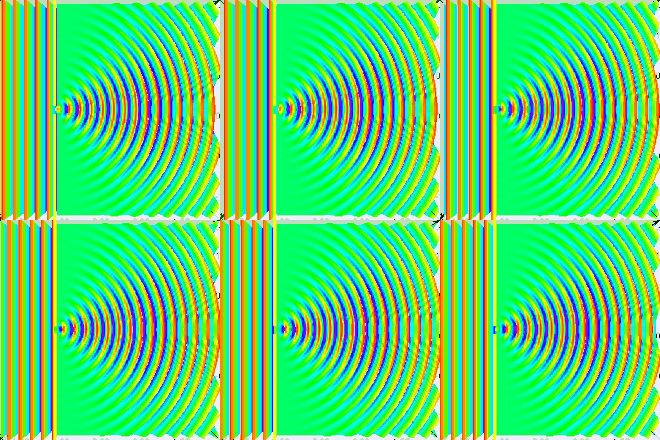
If there is an infinitely small hole this can be considered a spherical wave, but let's look up close and see what we actually get.
http://upload.wikimedia.org/wikipedia/commons/3/3c/Wave_Diffraction_4Lambda_Slit.png
This is a simulation but shows how the wave behaves at the scale of the slit. There is a broad peak in the middle and then smaller peaks off to the side, as can be seen in the next image, which shows the intensity when a screen is placed in front of the barrier.
File:Diffraction1.png
So how do we interpret these results? If the pressure of the wave is very high on the left of the barrier and low on the other side, then every point on the wavefront is spreading out due to the lower pressure from either side. This can then be considered as a collection of spherical wave sources. I have drawn four spherical wavesources in the next figure.

I have represented the top of the wave with a line, as it makes sense that the waves would spread out. But there are many more point sources. To help show how these add together I have blurred the waves after the barrier on the computer.

At the centre, there is constructive interference between all the waves which approaches a plane wave in the centre. Secondly, there are secondary waves coming off the sides which represent when the waves constructively interfere. We can now think of plane waves as an infinite number of point sources. Let's look at a simulation that should bring clearer understanding.


At the slit, there appear to be multiple point sources which are all radiating outwards in the centre. These constructively interfere to produce a plane wave but on the edges there are places of constructive and destructive interference. We decompose the plane wave into tiny spherical wave sources before adding them together to give us our macroscopic plane wave solution. Interestingly, this finite way of dealing with things has similarities to quantum theory, in which we deal with discrete quantities (quanta). However, the finite points are continuous over the slit which is not very quantum.

Now let's go back to our approximation of a slit as a spherical wave source, after which we can show that two slits form an interference pattern. Here, the mathematics can be greatly simplified, moving from an infinite number of point sources across both slits (which is how the Huygens-Fresnel principle solves the diffraction problem) down to two spherical point sources.

To begin with, let's look at this graphically by focusing on the interference patterns that emerge when  spherical waves are drawn on the computer.

As wavelength is increased, so is the distance between the spots where the waves constructively interfere on the barrier. If we increase the slit separation the spots come closer together. We need to develop some model to represent this mathematically.

Consider a barrier placed a long way away. Instead of looking at the interference from the slits to the screen, let's look at the interference on the barrier from the slits. To work out when the waves constructively interfere, we can work backwards to the slits.

Drawing a line from a point on the barrier to each of the slits, two lines are formed. As the barrier moves further away, these two lines will basically become parallel. This is an approximation, and only works if the ratio of the distance between the slits and the distance to the barrier is small. Let's zoom up and see what is happening.
By assuming that the two lines are parallel, let's draw a right angle triangle and say that the angle from the point to the slit is basically the angle inside. We then look at the path difference, which represents how the two spherical waves will interfere on the barrier. We see that we need an even number of wavelengths to have constructive interference; in this case we have two wavelengths' path difference. We would call this the second order diffraction spot.

Let's look at another simulation where the zero order can be seen in the centre, as well as the first and third order very dimly off centre. 
File:Doubleslit.gif
The wave picture accurately describes the interference pattern. However, light also acts like a particle. Some very important experiments proved that light can act like a point in space and time with a certain energy. Something that might help you see this is that in the lab we can count photons, which means that the particle must be in a certain place at a certain time. But a wave will be spread out in both directions into infinity and have no position but a particular energy. These two models are mutually exclusive - one deals with rates of energetic particles while the other involves waves that spread out in space and time. So we must turn now to the particle picture.

Particle picture

There is a lot to add to this. I have just being looking up Feymann diagrams and treating photons as particles that can interact with matter and virtual photons. I will do some more reading and outline the particle model in more detail soon. You will see that you can think of particles of photons scattering off matter but you must think of all of the possible paths to the barrier and summing together the phase of these different paths.


Friday, 5 July 2013

Microscopic Laser Inscribed Poetry


Since late last year we have been machining microscopic poetry onto different objects. This was a joint project with The Photon Factory in the Faculty of Science and the English department at the University of Auckland called Poetry off the Page.

So what is cool about the project? Well, we took ten objects that are not usually machined and were able to machine them all using our laser technology (femtosecond ultrafast lasers and nanosecond excimer lasers). The diversity of objects gave us a real challenge and we showed that you can machine anything using the ultra-fast laser technology (thanks to Fraser MacMillan for teaching me how to use the system).

Secondly, we were able to get people involved with science as well as engage with students and lecturers from the English department. This is one of the ways we are getting the word out about the laser machining technology we have available and seeing how our laser technology can impact different fields. We will be exhibiting the work in the entrance to the library at the University of Auckland over September, which will give everyone the opportunity to engage with laser micro-machining and poetry.

Thirdly, thanks to Robert Carter I got to have some fun with a Zoomable User Interface (ZUI). With a ZUI you can embed content at different zoom levels, kind of like zooming around a photo on a tablet. We have been using this technology for keeping zoomable lab notebooks which allows for a general overview of data as well as detailed information embedded within the document.

Finally, it gave me the perfect cover for machining the proposal onto the ring for my fiancee without any suspicion.

You can check it all out at poetryoffthepage.org.nz. So have some fun!

Sunday, 16 June 2013

Mosh Pits and Molecules

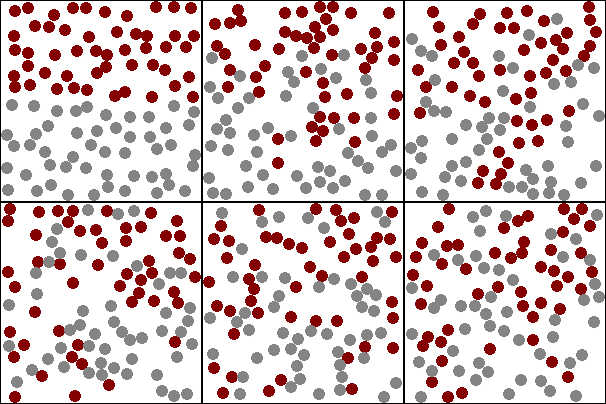
What do mosh pits and molecules have in common? Apparently their velocities can be described by the same statistics. For those born before heavy metal music, moshing is a style of dance often performed at the front of a stage at a live concert. People will energetically slam and push into each other.

Molecules' motion

Ideal gas animation (http://commons.wikimedia.org/wiki/File:Gaz_molecules.gif)
If I had been moshing and were to lift my arm up afterwards, others in the room would notice my body odour from the molecules in my armpit diffusing into the room. This random motion can be modeled using the Boltzmann distribution of energies:
$\frac{N_{i}}{N}=\frac{g_{i}exp(-E_{i}/kT)}{\sum_{j}g_{j}exp(-E_{j}/kT)}$
By using this formula we can think of all the different ways the molecules could be in (microstate) and we can work out the probability, which is in a particular arrangement. We can work out the distribution of the momentum (vector). $E=p^{2}/2m$. By putting this into the Maxwell distribution we can calculate the distribution of the velocity (vector) in a single direction.
$f_{v}(v_{i})=\sqrt{\frac{m}{2\pi kT}}exp(\frac{-mv_{i}^{2}}{2kT})$
Working out the distribution of speed which is now in three dimensions is easiest done using polar coordinates (like that of a world map) to switch from x,y,z to $v,\theta,\phi$ This requires a coordinate transformation.
$dv_{x}d_{y}d_{z}=v^{2}sin(\phi)dv d\theta d\phi$
This yields the probability distribution in three dimensions.
$f(v)=\sqrt{(\frac{m}{2 \pi kT})^{3}}4 \pi v^{2}exp(-\frac{mv^{2}}{2kT})$
The squared speed term says that the probability of having zero speed is zero and increases. The long tail comes from the exponential term. The assumptions made in modeling molecules like this are that:
  • The molecule has no volume.
  • All collisions are elastic (energy is conserved).
  • The molecules move randomly and are distinguishable from each other.

Moshing motion

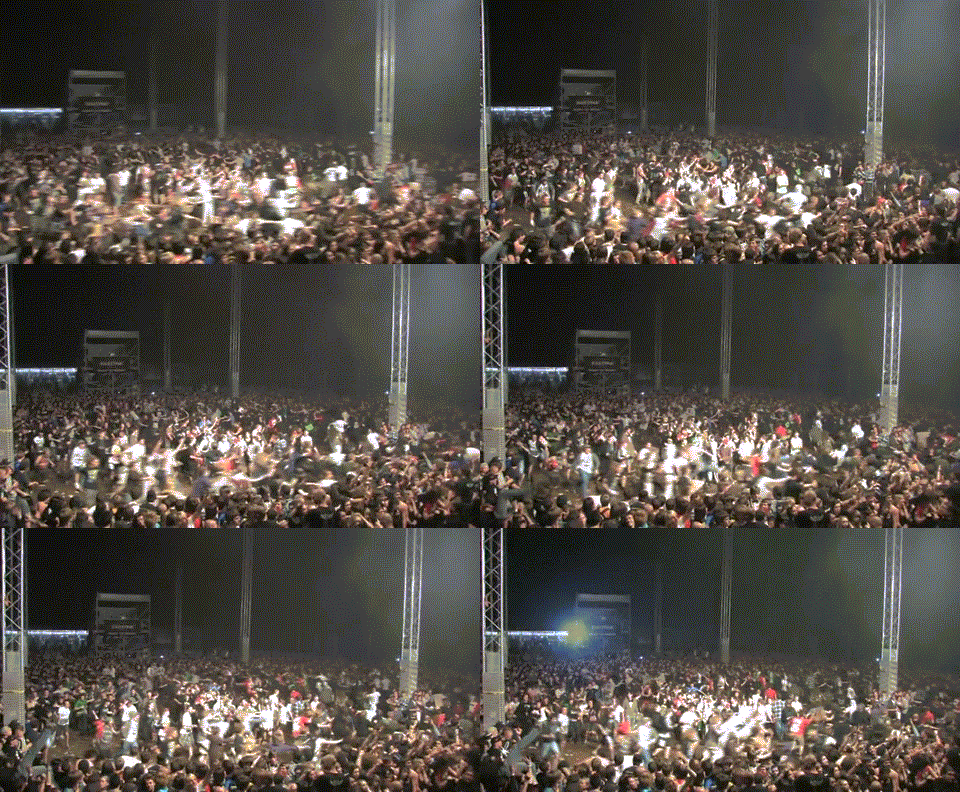
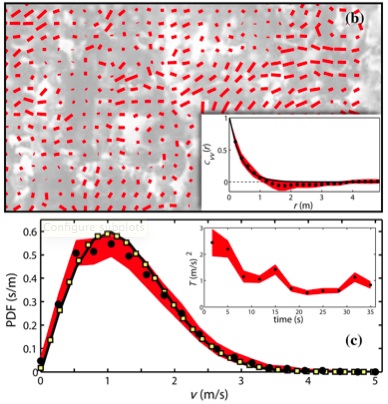
Particle tracking was applied to people in mosh and circle pits in heavy metal concerts. The most remarkable finding was that the velocities of the people in the mosh pit matched a Maxwell-Boltzmann distribution. The velocity-velocity correlation was then found to decay away with a decay length of 0.39+-0.03 m (about shoulder width apart) which suggests that the people move distinctly from each other.

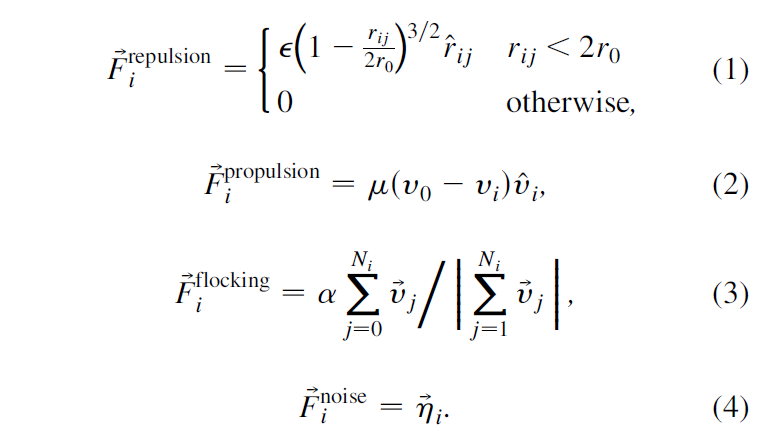
This motion is then modelled using flocking based forces, repulsion forces, propulsion forces and some noise. This is found to model the mosh pit accurately.


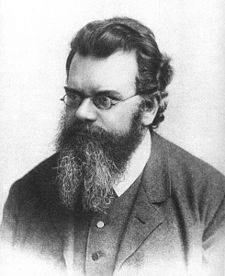
They then compare three different time scales - flocking time scales, noise time and collision time-related to the mean free path. Random motion from collisions and noise over long time scales reproduce statistics of classical gases which is how the non-equilibrium system can show equilibrium characteristics. When flocking dominates then you can get vortex states which result in angular momentum. These are called circle pits. Interestingly, the majority of these observed rotate counter-clockwise (95%). This was not predicted by the model but may be due to handedness/footedness. This presents an interesting analogue to a classical gas with all the particles distinguishable not correlated with enough chaos to show Maxwell-Boltzmann distribution in the macroscopic world. I wonder if Boltzmann would have been into heavy metal moshing. Maybe it’s just the beard.

 They also have this awesome javascript mosh pit simulator.

Silverberg, J. L., Bierbaum, M., Sethna, J. P., & Cohen, I. (2013). Collective Motion of Humans in Mosh and Circle Pits at Heavy Metal Concerts. Physical Review Letters, 110(22), 228701. doi:10.1103/PhysRevLett.110.228701