|
| SEM of hi-vis vest retroreflector |
Our teaching fellow Su (
see her blog here) has been working in our lab and is interested in the science around hi-vis vests. Photographing a hi-vis vest with the flash on, you can see the vest light up where the metallic bands are placed (photo above). These metallic looking bands are called retroreflectors, and they have the amazing ability to reflect light back at the same angle that it hit the surface. This is very strange as most surfaces reflect light in one of two ways, diffuse and specular (diagram below).
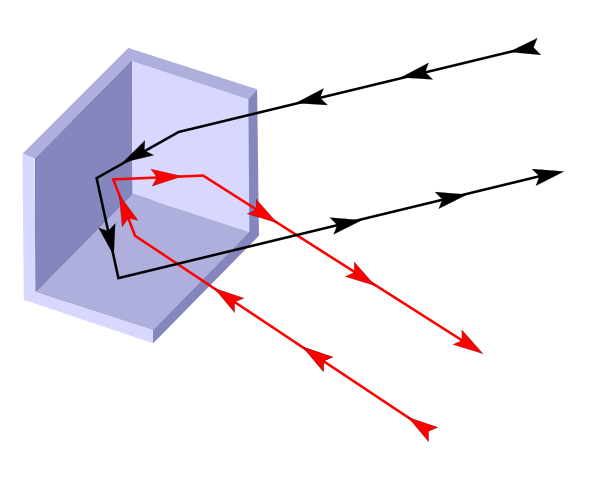
Specular reflection is where the incident light and reflected light approach and leave the surface at the same angle. Think of a mirror for specular reflection. Diffuse reflection often happens when a surface is rough, and light is reflected in all different directions compared with the incident beam. A retroreflector does something unexpected - the incident beam and the reflected beam go in and come out in the same direction, parallel to each other.
This ability means that light coming from the flash of a camera bounces straight back into the lens, which is why retroreflectors look so bright under a flash.
Seeing as it is the year of light and we are talking about different light-based technologies (photonics) I thought I would explain how a retroreflector works.
Corner cube
The most basic retroreflector design is a corner cube where three mirrors are placed at right angles to each other. The incident beam will always be parallel to the reflected beam, as seen below.
By adding many of these together you can make an array of corner cubes. These are often used on bikes.
Looking close up at the surface you can see the corner cubes which reflect the light back towards the light source. There is even one of these on the moon that was placed by Apollo 11 scientists.
However, corner cubes is not what we found when we put the hi-vis vest retroreflector surface under the scanning electron microscope.
Cats eyes
This is what we found on the retroreflector surface: small glass balls stuck to the fabric in a single layer.
They are about 60-90 microns across, about the size of a human hair. To give you some scale we put one of Su's hairs on the surface.
On the right is the carbon tape we used to hold the hair down (bottom left corner of the picture). We didn't end up coating the retroreflector with gold, which would have stopped the bright spots you see on the structures. These spots are due to electrons getting stuck to the glass and not being able to drain away; we call this charging of the sample.
The cats eye works in a similar way to the corner cube but instead of two angled mirrors the light is reflected from the back of the sphere.
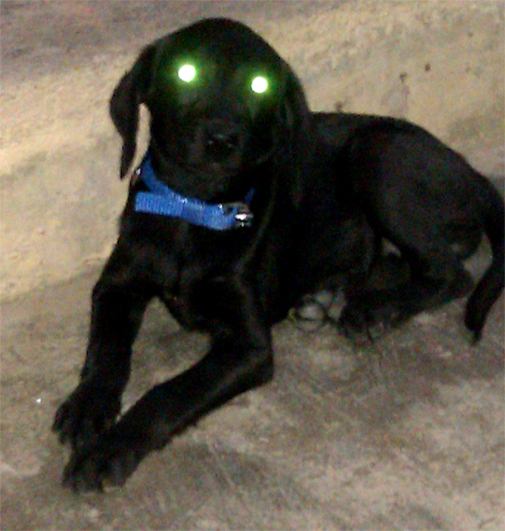
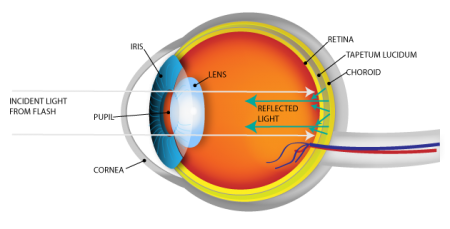
This is the same effect that leads to animals' eyes glowing in head lights or camera flash.
The back of many animals' eyes has a layer called the Tapetum Lucidum. This layer reflects light that is not absorbed by the eyes' light sensors in the retina the first time they pass through. This gives the light a second opportunity to be absorbed by the retina and is found in animals that need good vision in low light conditions, such as nocturnal animals.
Another fun effect I found when I added water to the surface was iridescence (colour reflected at different angles). I am unsure if this is a
photonic crystal effect like opals or due to the
effect of rainbows coming from spheres.