

"We are only discovering what other people forgot, or chose not to do!"
With the passing of Mr Douglas Brian (Doug) Williams on 23 July, the world has lost a renewable energy visionary and a leader in the field of biomass gasification.
Doug was trained as a boilermaker in New Zealand and began working with Fluidyne Research & Development Ltd in the 1970s. During this time Fluidyne was developing oil filters to remove moisture from engine oil and develop tests for oil quality. Energised by the Gulf oil shock of 1973, Doug and others rebranded the company to Fluidyne Gasification Ltd in 1976 with the goal of bringing independence to New Zealand’s energy supply. The company began to work on and improve a 1900-1940s technology that had been developed during wartime oil shortages in Europe to power automobiles with woody biomass - downdraft gasification. Fluidyne started to cofire diesel generators with wood gas as well as modifying vehicles to operate on wood using the gasifier, such as Doug’s own van.

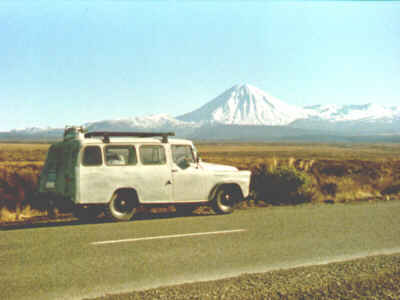
(left) Fluidyne’s uninsulated gasifier fuels a three cylinder diesel engine with vacuum governor, 1977. (right) Doug’s personal gasified van in the 1970s.
In 1977, the European Commission put out a call for remote electric power generation in the tropical region of the Pacific Ocean. Fluidyne got to work designing and building the Pacific Class gasifier rated for generating 30 kWe and by 1984 the first four units were sent to Fiji, Malaysia, South Africa and North America (Maine). The Pacific Class technology gained a lot of attention and was the winner of the New Zealand Steel Awards in 1984.
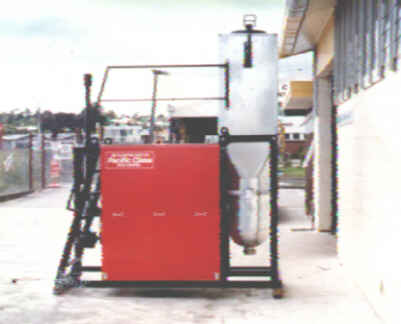
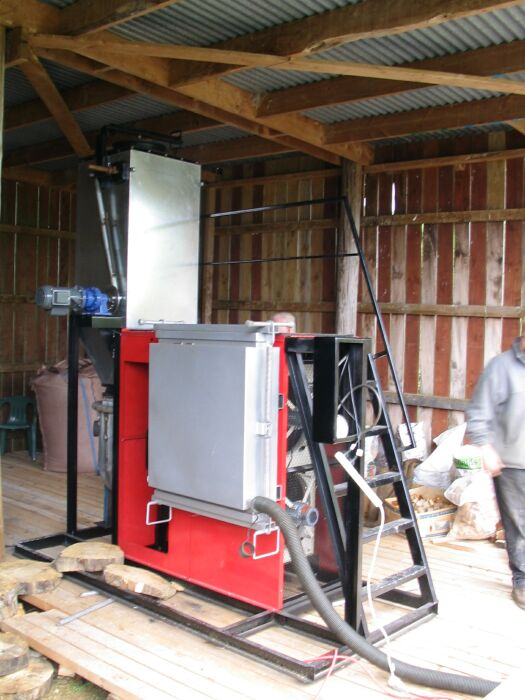
(left) Front view of Pacific Class gasifier. (right) The gasifier installed at a NZ farm.
Fluidyne Gasification Ltd quickly became a leader in small home and farm scale gasifiers. Fourteen Pacific Class gasifiers were built and sold to projects in Fiji, Malaysia, South Africa, Indonesia, USA, Mozambique, Pitcairn Island, Papua New Guinea, Uruguay, Germany and the UK. In 1987, Fluidyne designed the smaller 10 kWe Pioneer Class gasifier, which was designed for stationary power in a farm setting. The Pioneer Class gasifier did not end up being developed into a commercial unit but it lay the groundwork for the subsequent developments. For example, a unit was shipped to Massey University where it was used for training students under Prof. Ralph Sims.
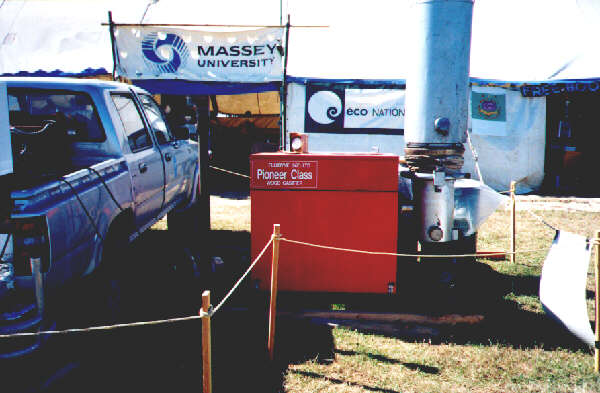

The Pioneer Class gasifier at a music festival.
Ahead of the curve, in 1978 Doug purchased land outside Kumeu and grew one of the first forests solely for fuel production in New Zealand. In his own words,
“The plan was to plant eucalyptus and coppice every seven years, and according to the New Zealand Forestry Department, this small plantation was the first purpose planted energy plantation in New Zealand. They even borrowed a few trees to cut down for a TV programme, so if nothing else, this plantation has served a useful purpose of education for they still stand today.”
At the same time native forests were developed on the land:
“The back of the farm has a reserved block of native forest regenerating from kauri timber cutting early in the 1900s. We have also shut off adjacent areas to keep stock out and it is regenerating the native species.”
At the back of the property he placed a Pioneer Class gasifier and power generator for educational purposes. Over the years many people would be trained on his properties to prepare and dry the fuel, and importantly, how to operate the gasifier.
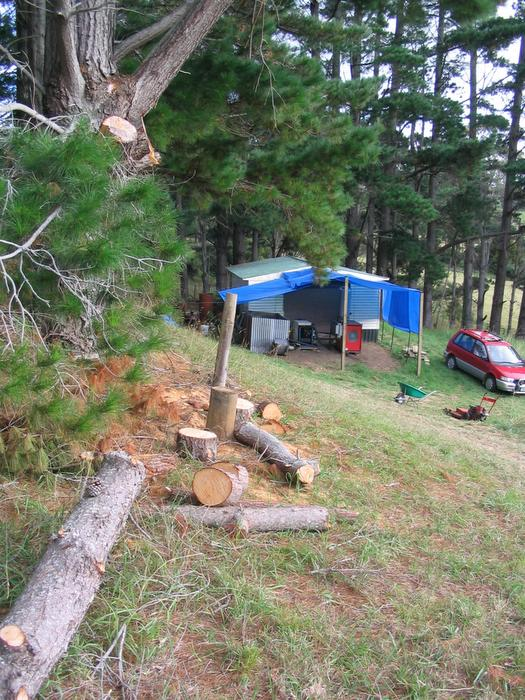
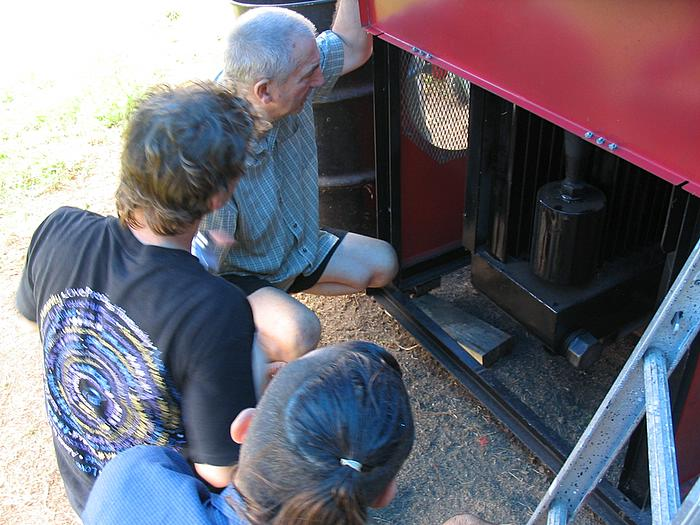
(left) The back shed where the forest and Pioneer Class gasifier was set up. (right) Doug demonstrating how to operate the gasifier in 2006.
Fluidyne Gasification Ltd was closed in 1998 with Doug’s retirement, however, Doug began collaborating with other companies around the world. In 1999, Innovation Technologies (Ireland) became involved with a gasifier project which led to them speaking with Doug and licensing Fluidyne’s technology to develop a commercial downdraft gasifier. From 2000-2004 they developed a 30 kWe gasifier based on the Pacific Class design and did extensive testing with sewage pellets and MDF. Parallel development of the larger Mega Class gasifier rated at 2 MWe was completed by ITI and built in Canada. This design used a linear hearth to provide incredible fuel throughput. The work with ITI culminated in the development of the Atlantic Class gasifier in 2005/2006 rated for generating 70-80 kWe.
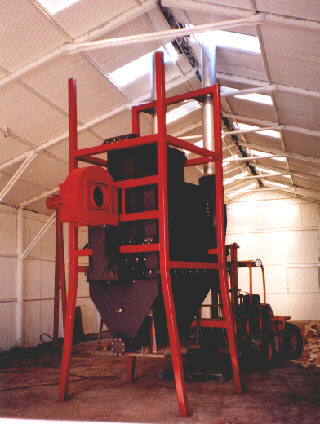
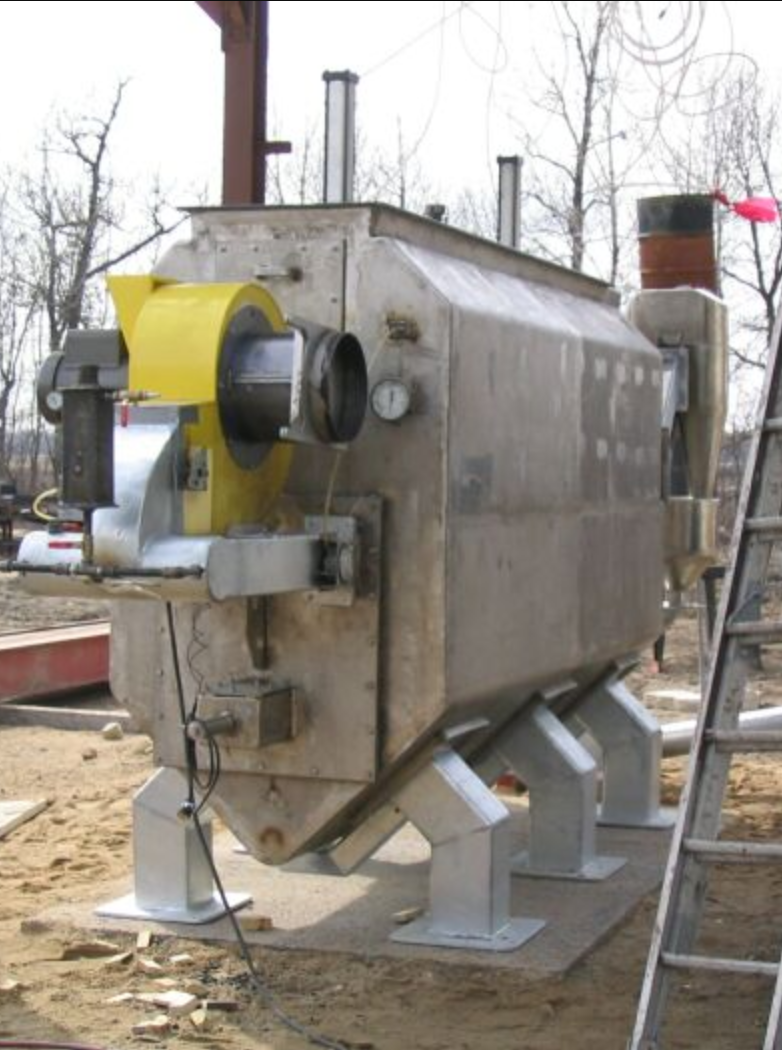
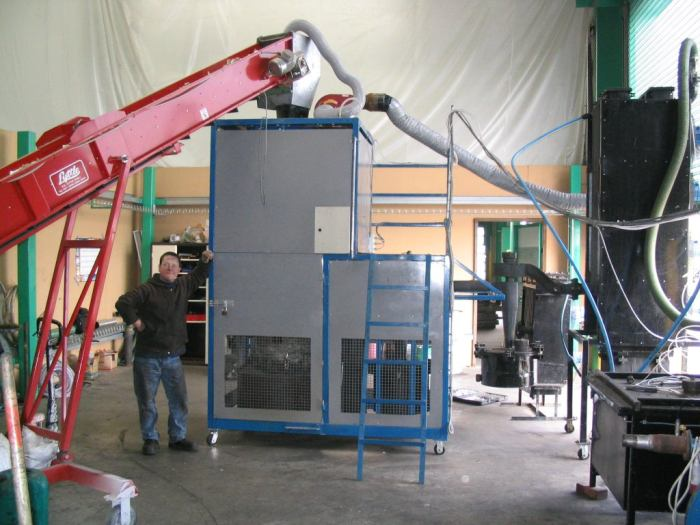
(left) Mega Class gasifier from 2000-2003 (middle) Mega Class gasifier mark two rated for 2 MWe in 2004. (right) Atlantic Class gasifier 70-80 kWe in 2005/2006.
Doug launched the Fluidyne Archive (http://fluidynenz.250x.com/) in 2001 to mark the 25th anniversary of the founding of Fluidyne Gasification Ltd. On the website he made available the designs for a low-cost, easy to assemble gasifier. This was based on a design brief provided by the gasification research team at Bremen University to develop a simply constructed wood gasifier for developing countries in 1989. The design was unique in that it avoided many of the expensive high temperature steels or refractories by using the charcoal itself as the insulating material. This simple design allowed for easy tuning of the gasifier to provide a tar-free gas. This was achieved by moving a tube into the oxidation lobes until the gas was forced to travel through the oxidation zone of the gasifier; the reduction zone was also easily tuned by varying the height of a grate during operation. The easy-to-dismantle top allowed the char bed to be meticulously taken apart to determine exactly where all of the zones were, which greatly aided in tuning the gasifier for the fuel to reduce the amount of tar produced. This provided one of the first, and potentially most influential, open source designs for gasifiers and was quickly picked up by a burgeoning DIY gasification community.
Doug’s support extended past simply providing plans - he actively engaged with those building the gasifiers and supported them to learn the technology. One example of this was his collaboration with Douglas Diaz from Chile. Doug visited Chile to commission the small DIY gasifier that was built in 2007. This collaboration lead to the development of the commercial Andes Class gasifier, a 100 kWe unit, which he again visited in 2008 to commission.
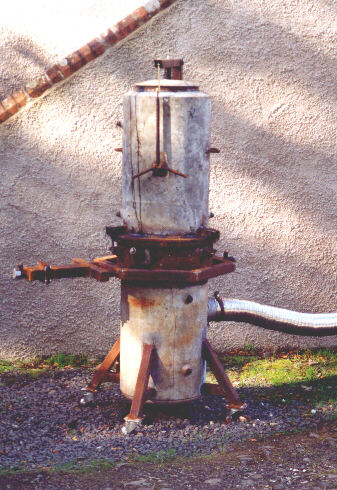
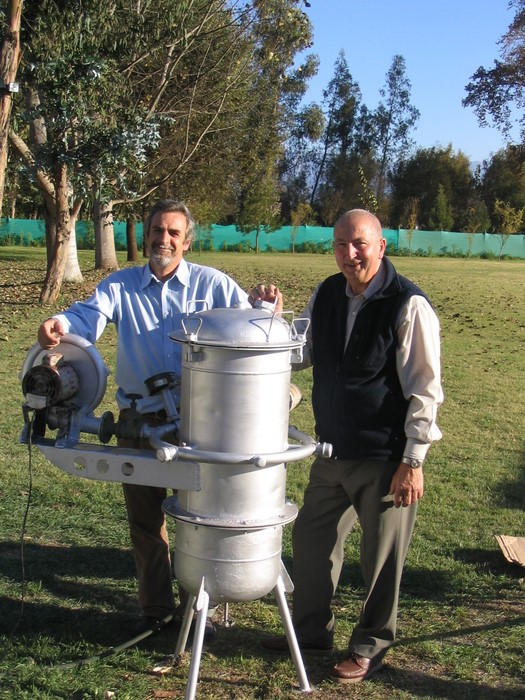
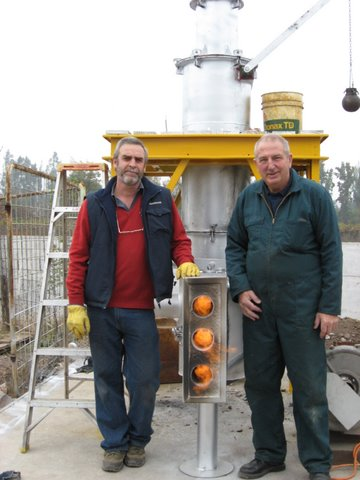
(left) Innovation Technologies Ireland gasifier built by summer students in 2002. (middle) Douglas Diaz and Doug Williams in Chile with the DIY gasifier design in 2007. (right) Andes Class gasifier 100 kWe in 2008.
In 2006, a Pacific Class gasifier was purchased by Calforest for heating their conifer nurseries. This led to a long collaboration between Doug and Tom Jopson from Calforest. Following the development of the Andes Class gasifier in Chile, Calforest built a similar unit. This developed into the Sasta Class gasifier in 2012/2013, which combined the Andes Class scale with the Mega Class linear hearth design to provide a high throughput gasifier that could produce heat but also significant amounts of charcoal for the nursery.

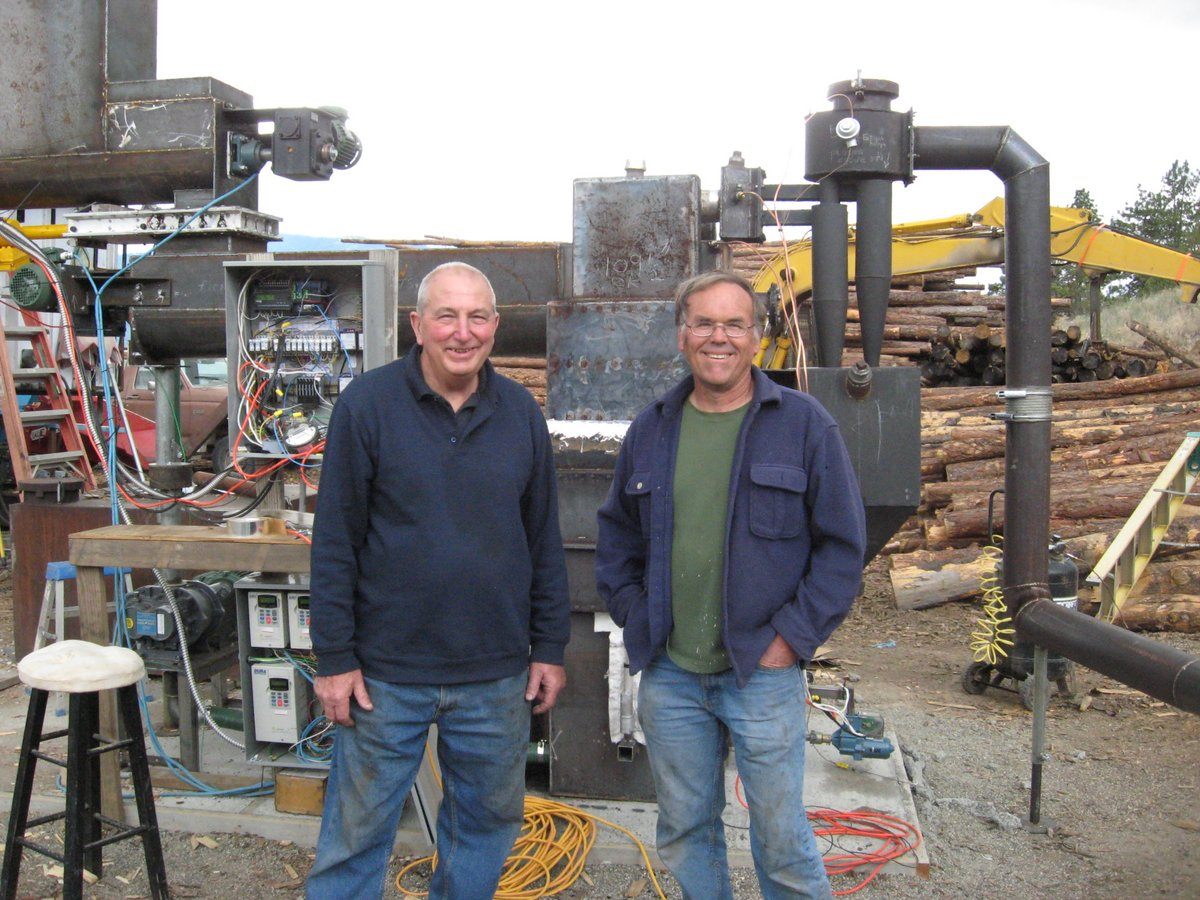
(left) Calforest Andes Class gasifier from 2008. (right) Doug and Tom Jopson from Calforest with the Sasta Class gasifier 100 kWe from 2012/2013.
Doug was also a pioneer of charcoal generating gasifiers. This technology is considered one of the critical carbon capture technologies required to counteract some of the most difficult CO2 emissions to eliminate, such as those from air travel. The heat treatment in the gasifier traps ~50% of the carbon photosynthetically captured by the tree in a stable char (often called biochar). The biochar can be sold as it improves the soil and can therefore provide incentives for carbon capture. Doug used the same linear hearth design from the Mega and Sasta Class gasifiers to design a char maker with Canadian company Alterna Energy in 2007. Calforest modified their Sasta Class gasifier to provide large volumes of char in 2017 during Doug’s last visit to California.


(left) Calforest’s Sasta Class gasifier in char making configuration, 2017. (right) Conifer seedlings without and with char.
Gasification Australia Pty Ltd was established in 2005/2006 and developed the Tasman Class gasifier. The gasifier was rated at 10-15 kWe, slightly larger than the Pioneer Class. Dr John Sanderson from Gasification Australia Pty Ltd went on to develop a mobile pyrolysis unit to produce charcoal from waste wood in the 2010s. At least three of these mobile units are in operation in Australia with the company Green Man Char selling the charcoal/biochar for gardening. One of these units has even been installed in Hong Kong’s Park and Garden Department to generate char for their nurseries.


(left) Mark 3 Tasman Class gasifier, 2009. (right) Charmaker mobile pyrolysis unit, 2014.
One of Doug’s most significant contributions was his generosity in educating people about gasification. Doug was very active on the early online forums such as the bioenergylists, which began in 1995, as well as the gas-to-fuel and wood gas Yahoo group forums. Within these platforms a new generation of engineers was trained and many projects and companies resulted. One company I will highlight is All Power Labs. All Power Labs began with American Jim Mason, who required off-grid power for his small art collective in 2002. This led to the development of an energy-hacking culture. Jim was very active on the gasifier bioenergy mailing list and exchanged many messages with Doug and others. In 2007/2008 they launched a low cost Gasifier Experimenter’s Kit (GEK) capable of generating ~10 kWe. This quickly led to a surge in hobbyists tinkering with the technology and generated a huge amount of interest. This developed into the Power Pallet technology in 2010, a turnkey downdraft gasifier capable of generating 25 kWe of electricity. As of 2013 All Power Labs has sold more than 500 units worldwide and supported research in at least 50 different universities. All Power Labs is now developing a 150 kWe container scale unit for larger scale applications. Other companies can certainly vouch for Doug’s contributions to their technologies. Many took the knowledge that Doug taught for downdraft gasification and brought ease of use through automation, providing truly turnkey products. Doug has been called one of the three pillars of biomass gasification on these forums, the other two being Mr Tom Miles and the late Dr Tom Reed, who passed away last October. Doug will be sorely missed in these online communities.

I (Jacob Martin) first interacted with Doug on these mailing lists in my mid-teens. He generously gave his time to discuss my designs and ground me in what was actually achievable through emails and phone calls. In 2008, I visited his farm and was trained on the Pioneer Class gasifier as well as the much smaller Micro Class gasifier/fuel tester. During the summer of 2008/2009 I constructed the Discovery Model gasifier, slightly larger than the Micro Class and able to generate 3 kWe. Doug taught me how to tune this gasifier for my fuel to produce tar free producer gas for power generation. This involved very carefully removing the char bed, layer by layer, and analysing every detail of the charcoal - is it shiny or covered in soot; how is it disintegrating as it is reduced? This provided a map of the different zones within the gasifier and allowed me to rapidly tune the grate and reduction tube to provide a clean continuous stream of fuel gas. I ended up doing many tests of the gasifier and submitting my research to regional and national science fairs in New Zealand. These competitions provided me opportunities to travel overseas and a summer internship gasifying algae biomass (more details can be found in a previous blog post). Doug developed this scale of gasifier into the Microlab Class gasifier in 2011 that was supplied to Ulster University for students to learn gasification and to facilitate research on different fuels with Dr Mark Anderson.
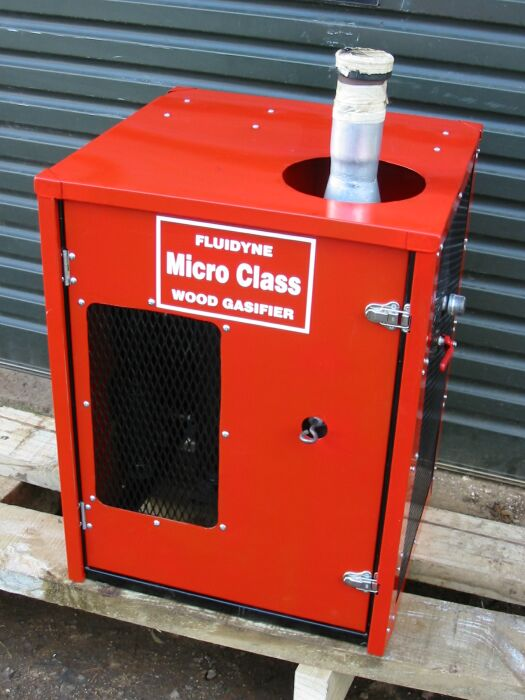

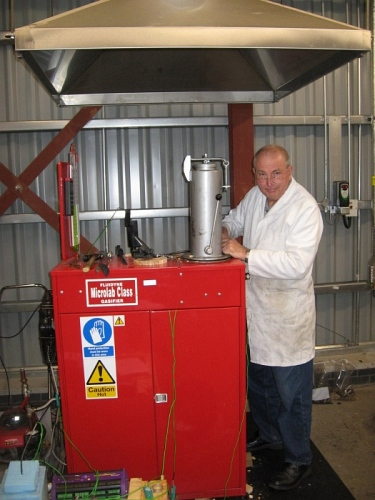
(left) Microclass gasifier fuel tester 2003. (middle) Me with the Discovery Model gasifier built in 2008. (right) Doug testing the Microlab Class gasifier at Ulster University, 2011.
Doug was also very observant and found that some of the char could be attracted to a high strength neodymium magnet. He asked me to look into it, which may have been the most important piece of guidance I have received and which led to my love of research. I got in contact with Prof. Merrilyn Manley-Harris and Prof. Brain Nicholson from Waikato University and began analytical analysis of the gasification charcoal. Using a variety of different instruments, we were able to show that the magnetism was due to iron in the wood being reduced to the ferromagnetic metal and was not due to the carbon material. However, this piqued my interest in the atomic arrangement of atoms in the charcoal, otherwise known as its nanoscale structure. Waikato University has been looking into the nanostructure of charcoal since 2007 using a variety of different instruments, such as mass spectrometers to weigh molecules that are laser ablated from the charcoal’s surface. I began to extend this work at Waikato and then Auckland University, leading me to a 10-year study of the nanostructure of gasification charcoal. I’m now doing a PhD at the University of Cambridge in the field of soot formation, which Doug also introduced me to.
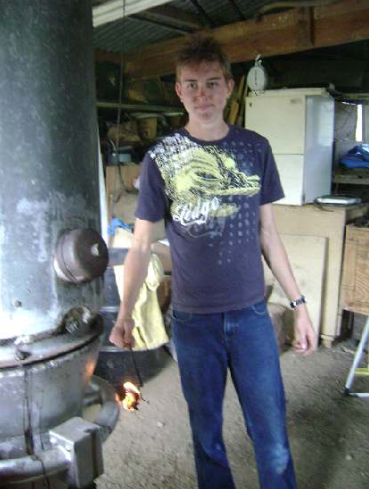
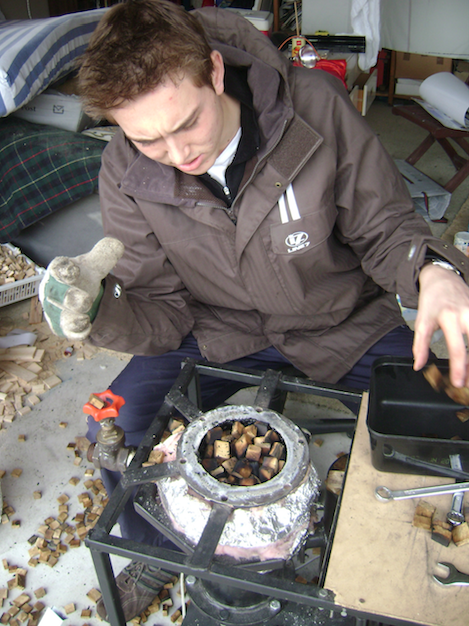
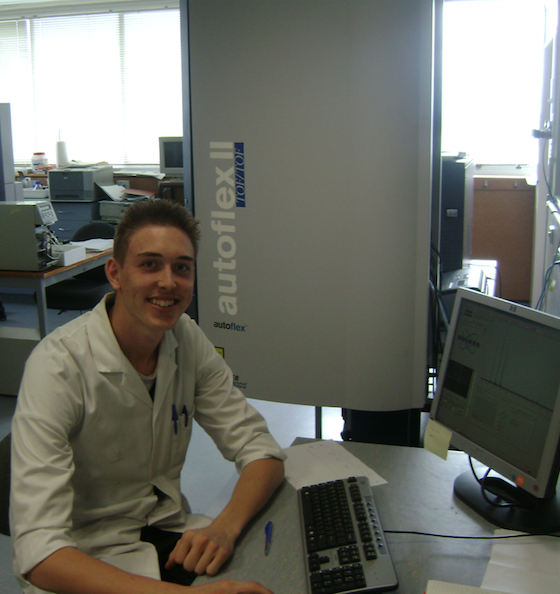
(left) Me at Doug’s shed lighting the Pioneer Class gasifier, 2008. (middle) Collecting samples from within the gasifier layer by layer. (right) The laser desorption ionisation time of flight mass spectrometer at Waikato University used to look at charcoal’s nanostructure.
This year we published our findings on the nanostructure of charcoal. The knowledge Doug provided was invaluable and allowed us to produce some incredibly high quality charcoal that was free of soot on the surface (secondary char) by carefully choosing the zone from which the charcoal was collected. The low tar content of the charcoal also allowed for the imaging of the nanostructure of the material in an electron microscope, which was not possible for most charcoals prepared in tube furnaces. The graphical abstract for the paper shown below shows a picture from within a Fluidyne gasifier zooming into the nanoscale features of the material (read more in my blog post on the paper).

On publication of the paper, Doug wrote to me to show his enthusiasm for this work, as he has throughout.
“I read it immediately, but failed to reply, mainly due to big distractions at my end. It was so interesting for me to see how the layers form, really like Jim Cousins said years ago when he described the gasifier soot as having graphite like properties. I'm not writing much at the moment, seems like a mind block to be interested at times, then I get all fired up again!”
I wanted to end on some more of Doug’s words. One of his famous mantras was
"We are only discovering what other people forgot, or chose not to do!"
By this he meant that we are only rediscovering the knowledge about gasification from the first wave of research at the beginning of last century.
His personal motivations and hope for the future of gasification are well summed up in one of his responses on the Gasification mailing list in 2011.
His personal motivations and hope for the future of gasification are well summed up in one of his responses on the Gasification mailing list in 2011.
“Gasification for me, is a survival technology. We live in a complex world of change, both political and environmentally, where overnight, we can see all we take for granted vanish in an instant. This doesn't motivate me to save anyone, but the lights will never go out in my house, thanks to gasified engine powered generation (but only when the grid goes down). The ability to survive sudden change has cost attached, but if considered as an Insurance Policy, gasified power generation has to be a serious contender for emergency power if nothing else.
What then, is there to offer future generations about gasification? Teach them to do it better, faster, and cleaner, cheaper, is that the best on offer for our expertise acquired at such great expense of time and money? As a gas, is it only considered to be chemical building blocks, and the waste char an in-thing, to be seen stuffed in the ground for carbon credits? Can gasification open a pathway to facilitate new sciences? Hmmm.”
1 January, 2011
Doug, you certainly taught me and many others the art and science of gasification that you re/discovered. You also passed on your huge enthusiasm and enjoyment for your work. Your legacy lives on in the many gasification projects still underway, the development of biochar for carbon capture and the ongoing fundamental science looking into charcoal’s nanostructure. While you did not see your vision for a biomass powered world, we will aim to further the technology and make it a future reality.


