Abstract: Grab a hot chocolate and get cosy for a fireside chat about a candle's flame and the embers left behind. Following the lead of Michael Faraday in his 1848 Royal Institution Christmas lectures, I will provide an updated chemical history of a candle - including some experiments for you to try at home. The fun doesn't end there - after a flame is extinguished, there's a wealth of discoveries to be made in the embers. Understanding the structure of these carbon materials begins with Rosalind Franklin, best-known for her work on DNA, and continues with simulations on a supercomputer. While there are still many unanswered questions around flames and carbon materials, these recent insights are enlightening and important for cleaning up our planet.

Showing posts with label fullerene-like. Show all posts
Showing posts with label fullerene-like. Show all posts
Wednesday, 10 June 2020
The Chemical History of a Candle and Structure of an Ember - Webinar

Wednesday, 28 August 2019
Unraveling the complex tangle of atoms in charcoal, glassy carbon and activated carbons
tl;dr: Scientists, myself included, were having trouble figuring out the nanostructure of disordered carbon (BBQ charcoal, or the material in your water filter). The structure is kind of like a graphite pencil, with layers of carbon, but these layers were tangled in a mess. We were able to use computers to reproduce this tangle of atoms and find out how they're connected. It turns out that the atoms are connected by warped, curved sheets that connect in 3D to resemble a foam. Stacking of the sheets, we think, is due to them being twisted together like a corkscrew. I've been trying to figure this out for a while and was very excited to work with researchers at Curtin University to shed some light on this long-standing problem in science.

Disordered 3D graphene network (1.5 g/cc similar density to charcoal). Shown as a surface mesh constructed from the graphene rings with the curvature coloured saddle-shape red, bowl-shape blue.
Unraveling the complex topology of disordered 3D graphenes
Disordered 3D graphenes may sound exotic but they are ubiquitous. They are the carbon materials found in BBQ charcoal, batteries' electrodes, water filters, gas masks, high-temperature ceramics, electrochemical sensors and insulation, and were even used to protect the Parker solar probe spacecraft from burning up on its approach to the sun.
Rosalind Franklin, the scientist who would later deduce the helical geometry of DNA, first discovered this class of materials in 1951. Most carbon-containing materials develop small layered regions of graphene when heated. Upon further heating, to thousands of degrees, she found (to her surprise) a complete reluctance of the carbons to convert to the most stable form of carbon graphite - making it supremely metastable.
Explanations for this reluctance to graphitise have centred around the integration of non-hexagonal rings which warp the network into either bowl-shaped fullerene or theoretically explored saddle-shaped schwarzite nanoforms of carbon, which are foam-like carbon networks. However, the nanostructures were unable to be resolved from experiments.
Researchers from Curtin University and the University of Cambridge this week published a possible solution to Franklin's problem in Physical Review Letters. They turned to large scale simulations using Australia’s Pawsey supercomputer to self-assemble the largest and most accurate networks of disordered 3D graphene networks to date.

Curtin Carbon group visualising a large scale carbon network using the Curtin Hive immersive display Twitter.
Working with researchers at the University of Cambridge they developed a new metric for the global curvature of the networks, they found that for all structures an excess of saddle-shaped graphene sheets are present. These saddle shapes are caused by the integration of 7- or 8-membered rings within the hexagonal graphene network. This warping allows it to connect in 3D and the researchers suggest it is the cause for the material's resistance to convert into graphite.

New nanostructure proposed for disordered 3D graphenes with bowl-, saddle- and ribbon-like graphene sheets. With increasing density, screw dislocations allow for winding up and layering of the network.
How about Franklin’s small regions of layered graphene? The researchers found that upon increasing the density of the material, the graphene sheets wound up like a spiral staircase. This screw or helix defect is well known in graphite but has not been suggested in these disordered materials. A variety of other defects were discovered, which resolve many issues of the graphene network being both curved and layered.

Defects observed in disordered 3D graphenes.
These results open up possibilities for understanding and engineering carbon materials for applications in supercapacitors, carbon fibres and high-temperature ceramics applications. However, more work is needed to experimentally confirm some aspects of the model.
In terms of new applications, the researchers suggest that carbon materials could be topologically tuned and optimised for a given product. For example, how could you steer a carbon towards becoming graphite (of particular industrial importance for making batteries and electrodes)? This could open up many more materials for transformation into graphite, used in battery anodes, instead of having to mine the graphite.
In terms of new applications, the researchers suggest that carbon materials could be topologically tuned and optimised for a given product. For example, how could you steer a carbon towards becoming graphite (of particular industrial importance for making batteries and electrodes)? This could open up many more materials for transformation into graphite, used in battery anodes, instead of having to mine the graphite.
There is a pleasing connection with Franklin's later work on DNA in that the solution to her earlier problem of non-graphitisability in carbon materials could also lie in topology and the famed helix structure.
Read the preprint here while the paper is published in Physical Review Letters.
Thanks to Carla de Tomas, Irene Suarez-Martinez and Nigel Marks from the Carbon group at Curtin University for an excellent collaboration!
Thanks to Carla de Tomas, Irene Suarez-Martinez and Nigel Marks from the Carbon group at Curtin University for an excellent collaboration!
Monday, 3 September 2018
Fingerprinting soot: finding curved aromatics in soot
 |
| Fingerprints of molecules in soot particles imaged in an electron microscope showing curved species in the early flame. |
Fingerprinting is a unique way of identifying people by reading off the ridges found on a person's fingers. In a new paper, I and some colleagues used an electron microscope to image the fingerprint of aromatic molecules in early soot particles, finding evidence for a large number of curved molecules, which could be important for reducing soot pollution. Here is a link to the paper or to the open access preprint, "Flexoelectricity and the Formation of Carbon Nanoparticles in Flames". Here is a short video explaining the findings.
Soot emissions cause many deaths around the world while also contributing to global warming, but scientists are still at a loss to explain how soot is formed. We have previously suggested a new mechanism where aromatic molecules curve via pentagon integration and become electrically polarised, interacting strongly with charged species produced in the flame. However, as of yet, no one had measured just how curved (and therefore polar) the molecules are in the early soot particles.

To answer this question we imaged the molecules in soot on the nanoscale. To collect some soot we injected a small copper grid covered in amorphous carbon into a flame very similar to a candle. Soot stuck to the amorphous carbon and using an electron microscope we were able to image the molecules in the soot particles sticking to the grid. As you can see in the first image of this post we could convert the dark regions of the image, corresponding to aromatic molecules on their side, into lines. We could determine how many molecules that we imaged indicate pentagonal ring integration and we found this value to be greater than 62.5% of the fringes. This high amount suggests that they are important for soot formation.
We found even in the earliest soot particles sampled at the lowest height, which give us the most insight into soot formation, long fringes 0.9-1.0 nm in length are present (around 15 aromatic rings). We then simulated three curved aromatic molecules of the same length with one, two and three pentagonal rings, providing different amounts of curvature, and computed the tortuosity/curvature. From this analysis, we could conclude that early soot particles (at 10 mm above the flame) have a tortuosity/curvature indicating that two pentagons rings are integrated. Below is a figure of the molecule which corresponds to the average species around 1 nm in width with two pentagonal carbon rings.

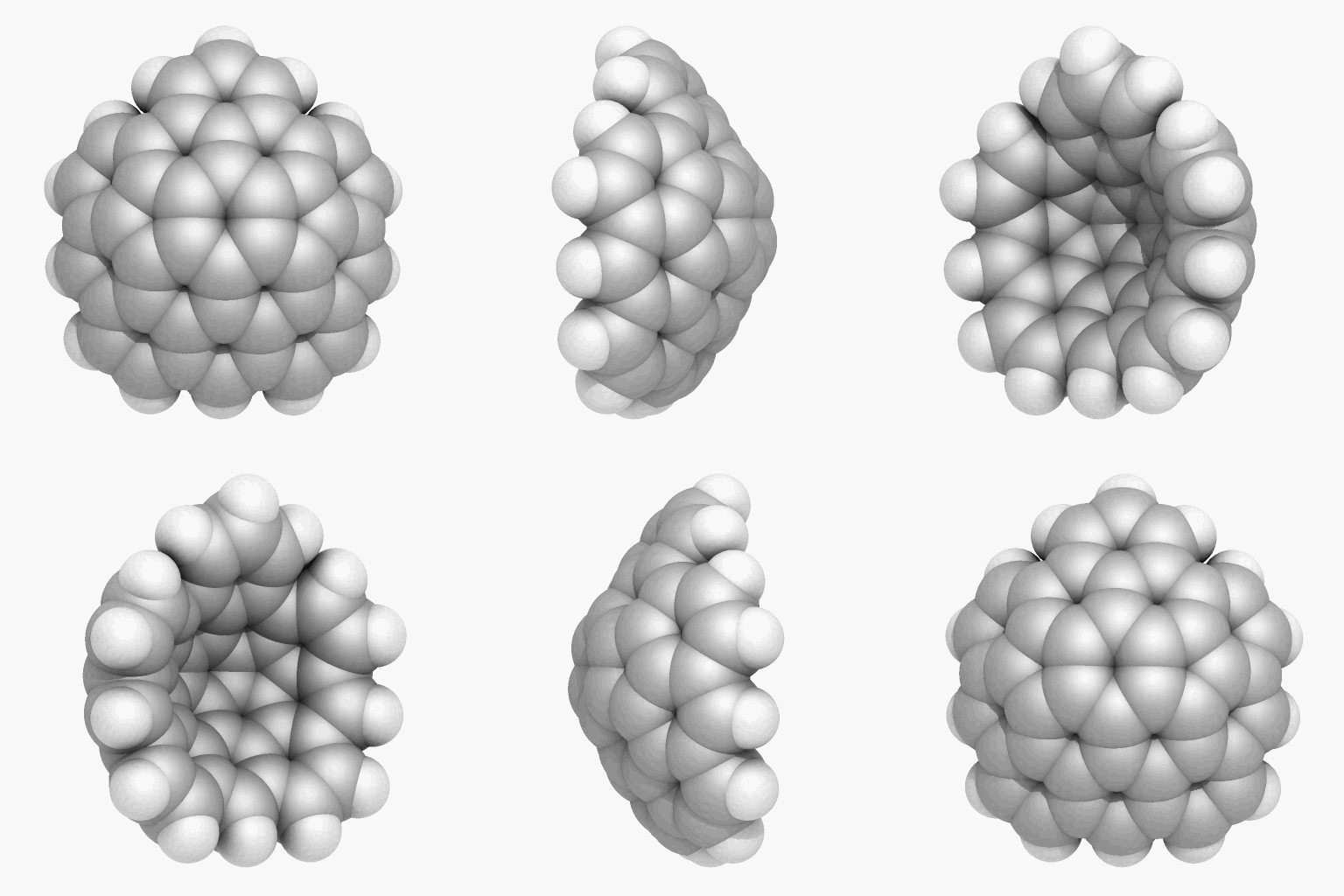
Computing the electric polarisation due to the curved structure, we found a large value of 5.32 debye - around three times that of water, which is substantial. Below is a plot of the electric potential around the molecules introduced earlier.

We found this molecule bound very strongly to charged chemi-ions which are produced in abundance in the flame, using computer simulations.

The strong interactions of these polar aromatic with chemi-ions need to be explored in more detail as it might help explain many of the electrical effects that have been seen, such as the ability of an electric field to stop soot formation in certain circumstances.
Subscribe to:
Posts (Atom)